
This is a discussion of Peter Thiel's Wall Street Journal Essay, Competition Is for Losers. It is part of a series of foundational texts on What is a startup business?
You can purchase Peter Thiel's book below:
What all of these pictures have in common is a narrative that goes something like this: scrappy outsiders, possessed of a unique genius, took outrageous risks and worked incomprehensible hours to beat the odds. (Ries)
Millions of companies are started every year in the US. Only a tiny fraction are startups. Most are service businesses—restaurants, barbershops, plumbers, and so on. These are not startups, except in a few unusual cases. (Graham)
Imagine you're running one of those restaurants in Mountain View. You're not that different from dozens of your competitors, so you've got to fight hard to survive. If you offer affordable food with low margins, you can probably pay employees only minimum wage. And you'll need to squeeze out every efficiency: That is why small restaurants put Grandma to work at the register and make the kids wash dishes in the back. (Peter Thiel)
Paul Graham: A startup is a company designed to grow fast. Being newly founded does not in itself make a company a startup. Nor is it necessary for a startup to work on technology, or take venture funding, or have some sort of "exit". The only essential thing is growth. Everything else we associate with startups follows from growth. (Graham)
The only thing that matters is getting to product/market fit. (Andreesen)
All happy companies are different: Each one earns a monopoly by solving a unique problem. All failed companies are the same: They failed to escape competition. (Thiel)
Steve Blank: a startup is an organization formed to search for a repeatable and scalable business model. (Blank)
A startup is a human institution designed to deliver a new product or service under conditions of extreme uncertainty. (Reis)
In this post we’re going to offer a new definition of why startups exist: a startup is an organization formed to search for a repeatable and scalable business model. (Blank)And then he unpacks the idea of a business model.
A business model describes how your company makes money. (Blank)So a startup is an organization formed to search for a repeatable and scalable way to make money. That sounds like any business. What sets Blank's theory apart is probably the detailed process he lays out to form such a business.
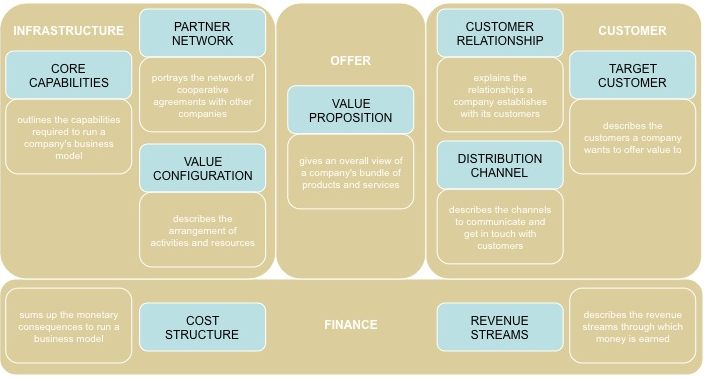
Your job as a founder is to quickly validate whether the model is correct by seeing if customers behave as your model predicts. Most of the time the darn customers don’t behave as you predicted. (Blank)The benefit of this advice is it focuses energies on hypothesis testing early on.
"It's not about pop culture, and it's not about fooling people, and it's not about convincing people that they want something they don't. We figure out what we want. And I think we're pretty good at having the right discipline to think through whether a lot of other people are going to want it, too. That's what we get paid to do.This is not the first time Jobs had said this.
"So you can't go out and ask people, you know, what the next big [thing.] There's a great quote by Henry Ford, right? He said, 'If I'd have asked my customers what they wanted, they would have told me "A faster horse." ' "(Steve Jobs)
A startup is a company designed to grow fast. Being newly founded does not in itself make a company a startup. Nor is it necessary for a startup to work on technology, or take venture funding, or have some sort of "exit." The only essential thing is growth. Everything else we associate with startups follows from growth. (Paul Graham)
A good growth rate during YC is 5-7% a week. If you can hit 10% a week you're doing exceptionally well. If you can only manage 1%, it's a sign you haven't yet figured out what you're doing.The best thing to measure the growth rate of is revenue. The next best, for startups that aren't charging initially, is active users. That's a reasonable proxy for revenue growth because whenever the startup does start trying to make money, their revenues will probably be a constant multiple of active users. (Paul Graham)
weekly | yearly |
1% | 1.7x |
2% | 2.8x |
5% | 12.6x |
7% | 33.7x |
10% | 142.0x |
If you want to understand startups, understand growth. Growth drives everything in this world. Growth is why startups usually work on technology—because ideas for fast growing companies are so rare that the best way to find new ones is to discover those recently made viable by change, and technology is the best source of rapid change. Growth is why it's a rational choice economically for so many founders to try starting a startup: growth makes the successful companies so valuable that the expected value is high even though the risk is too. Growth is why VCs want to invest in startups: not just because the returns are high but also because generating returns from capital gains is easier to manage than generating returns from dividends. Growth explains why the most successful startups take VC money even if they don't need to: it lets them choose their growth rate. And growth explains why successful startups almost invariably get acquisition offers. To acquirers a fast-growing company is not merely valuable but dangerous too. (Paul Graham)
A startup is a human institution designed to deliver a new product or service under conditions of extreme uncertainty. (Reis)He goes on to take that sentence apart, and defends the use of key phrases, arguing that they are critical. The words that he explains are "human," "new" and "uncertainty."
Even for companies that essentially have only one product, the value the company creates is located not in the product itself but with the people and their organization who built it. (Reis)And the point he makes here is that the systems and habits that a company generates may be as valuable as a piece of technology. Paul Graham explicitly calls new ways of doing this a new technology in the "broad" sense:
The other connection between startups and technology is that startups create new ways of doing things, and new ways of doing things are, in the broader sense of the word, new technology. (Graham)Although Thiel positions himself contra the lean startup, I don't think he would disagree with this component. One alternative view, however, may come form Marc Andreessen who specifically thinks that a market can pull a product form a mediocre team. Reis is closely aligned with Blank, who acknowledges the centrality of the product market fit in the lean model.
And yet the newness of a startup’s product or service is also a key part of the definition. This is a tricky part of the definition, too. I prefer to take the most expansive possible definition of product, one that encompasses any source of value for a set of people who voluntarily choose to become customers. (Reis)In his emphasis on novelty, Reis sounds closest to Thiel who emphasizes novelty more than almost anyone else we look at. However, Reis has a different idea of novelty:
Even the most radical new inventions always build upon previous technology. Many startups don’t innovate at all in the product dimension, but use other kinds of innovation: repurposing an existing technology for a new use, devising a new business model that unlocks value that was previously hidden, or even simply bringing a product or service to a new location or set of customers previously underserved. (Reis)Contrast: This may contrasts with Thiel's notion of a startup because I suspect other improvements would count as 1 to n improvements for Thiel. These improvements would not lend themselves to sufficient differentiation to earn a monopoly.
Startups are designed to confront situations of extreme uncertainty. To open up a new business that is an exact clone of an existing business, all the way down to the business model, pricing, target customer, and specific product may, under many circumstances, be an attractive economic investment. But it is not a startup... (Reis)
Thus, the land of startups is a unique place, where the risks themselves are unknown. ... Startups are designed for the situations that cannot be modeled, are not clear-cut, and where the risk is not necessarily large – it’s just not yet known. (Reis)
